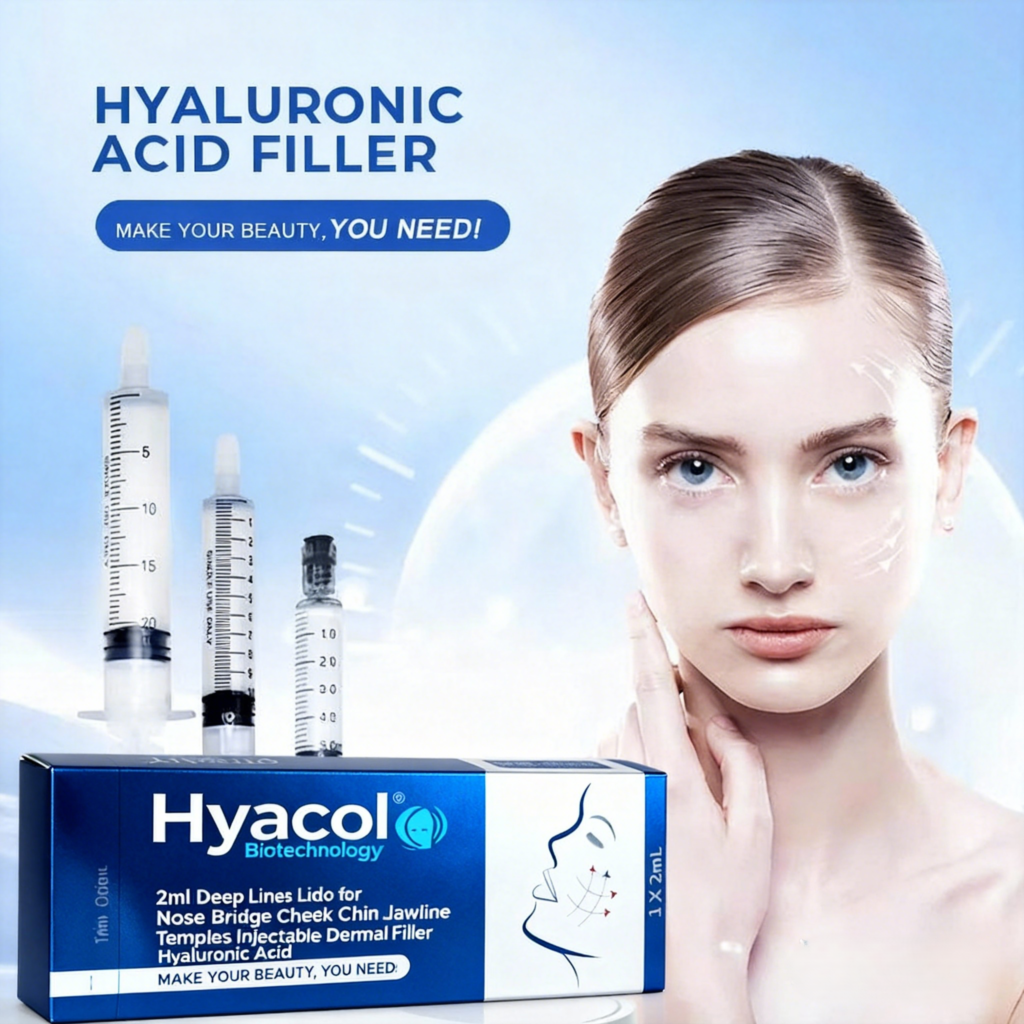
Hyaluronic acid (HA) dermal fillers have revolutionized aesthetic medicine, offering non-surgical solutions for facial rejuvenation, volume restoration, and skin enhancement. As a leader in biomedical innovation, Hyacol Biotechnology explores the scientific foundations, market dynamics, and future trends shaping this rapidly evolving industry. With the global HA dermal filler market projected to reach USD 8.1 billion by 2030, understanding these developments is critical for practitioners and patients alike .
The Science Behind HA Dermal Fillers
Hyaluronic acid is a naturally occurring glycosaminoglycan that maintains skin hydration and elasticity by binding water molecules—up to 1,000 times its molecular weight . Aging reduces endogenous HA production, leading to wrinkles and volume loss. HA-based fillers address this by replenishing lost volume, with effects lasting 6–18 months depending on cross-linking density and injection site . Modern fillers utilize advanced cross-linking technologies to enhance longevity while minimizing adverse reactions. For example, single-phase products (54.9% market share) offer uniform consistency for smoother integration, while duplex products provide structural support for deeper volumization .
Types of HA Fillers and Their Applications
The market caters to diverse needs through specialized formulations:
- Single-Phase Fillers:
- Used in 68% of nasolabial fold corrections due to their homogeneous gel structure .
- Ideal for fine lines and subtle enhancements, with viscosity ranges of 20–40 Pa·s for controlled injection .
- Duplex Fillers:
- Dominate 61% of cheek augmentation procedures .
- High elasticity (modulus >150 Pa) provides lift for contours like jawlines and chins .
- Emerging Formulations:
- Lidocaine-integrated fillers (72% adoption in clinics) improve patient comfort .
- RHA® Collection adapts to dynamic facial movements, reducing fracture risk under stress .
Applications vary by demographic and aesthetic goals:
- Lip Augmentation: The fastest-growing segment (CAGR 10.7%), driven by patients aged 21–35 .
- Facial Sculpting: Jawline and cheek procedures increased by 33%, with men representing 19–24% of users .
- Preventive Treatments: Adults under 30 now account for 18% of first-time procedures .
Market Growth and Regional Trends
The global HA dermal filler market is expanding at a CAGR of 7.8%, fueled by rising demand for minimally invasive procedures . Key regional insights include:
- North America: Leads with 41% market share (6.1 million annual procedures) .
- Asia-Pacific: Fastest-growing region (10.3% CAGR), with preventive aesthetics driving 34% of demand .
- Europe: Holds 29% market share, with Germany and France leading in reconstructive-aesthetic hybrid treatments .
Growth is propelled by demographic shifts:
- Aging populations (60+ year-olds to reach 2.1 billion by 2050) seek wrinkle reduction .
- Social media influences 58% of facial aesthetic adoptions .
Innovations and Future Outlook
Technological advancements are reshaping the industry:
- Longevity Enhancements: Cross-linking technologies extend filler durability by 42–55% .
- Combination Therapies:
- 47% of patients opt for hybrid treatments (e.g., fillers with neuromodulators or energy-based devices) .
- Biostimulatory fillers like Ellansé® stimulate collagen for results lasting 2+ years .
- Sustainability Focus:
- Brands adopt recyclable packaging and cruelty-free testing to meet ethical consumer demands .
Hyacol Biotechnology emphasizes the importance of personalized formulations and safety protocols. With AI-assisted imaging used in 52% of high-volume clinics, precision planning minimizes risks like vascular occlusion (0.04–0.1% incidence) .
Conclusion
The HA dermal filler market combines scientific innovation with evolving consumer preferences, offering safe, effective solutions for aesthetic enhancement. As demand grows for natural-looking results and sustainable practices, Hyacol Biotechnology remains committed to advancing research and supporting practitioners with evidence-based insights. The future will likely see broader applications—from hand rejuvenation to collagen-biostimulatory hybrids—ushering in an era of personalized, holistic aesthetics .
Hyacol Biotechnology provides cutting-edge insights and solutions for aesthetic medicine. Explore our resources to stay ahead in this dynamic field.